Loan Officer Business Plan Template

If you're writing a loan officer business plan template, there's one big choice you need to make right away: will you be a broker or a lender?

A broker connects borrowers with other companies that give out the loans. The broker earns a small fee for making the match. A lender uses its own money to give out the loans. It earns money from the difference between what it costs to borrow that money and what it charges borrowers, minus any loans that don't get paid back.

These are two very different businesses, so this template covers both, and it starts by asking you to pick one, because mixing them together makes the plan confusing. Once you know which one you are, everything else follows: what loan products you'll offer, who you'll partner with for funding, what licenses you'll need, and how many loans you need to close before you start covering your costs.

As an example throughout this template, we'll look at ClearPath Lending, a company that chose the lender path. By Year 3, half of its income comes from interest, it keeps 75.4% of its revenue as profit before expenses, and it's raising $382,000, most of which goes toward building its lending platform.
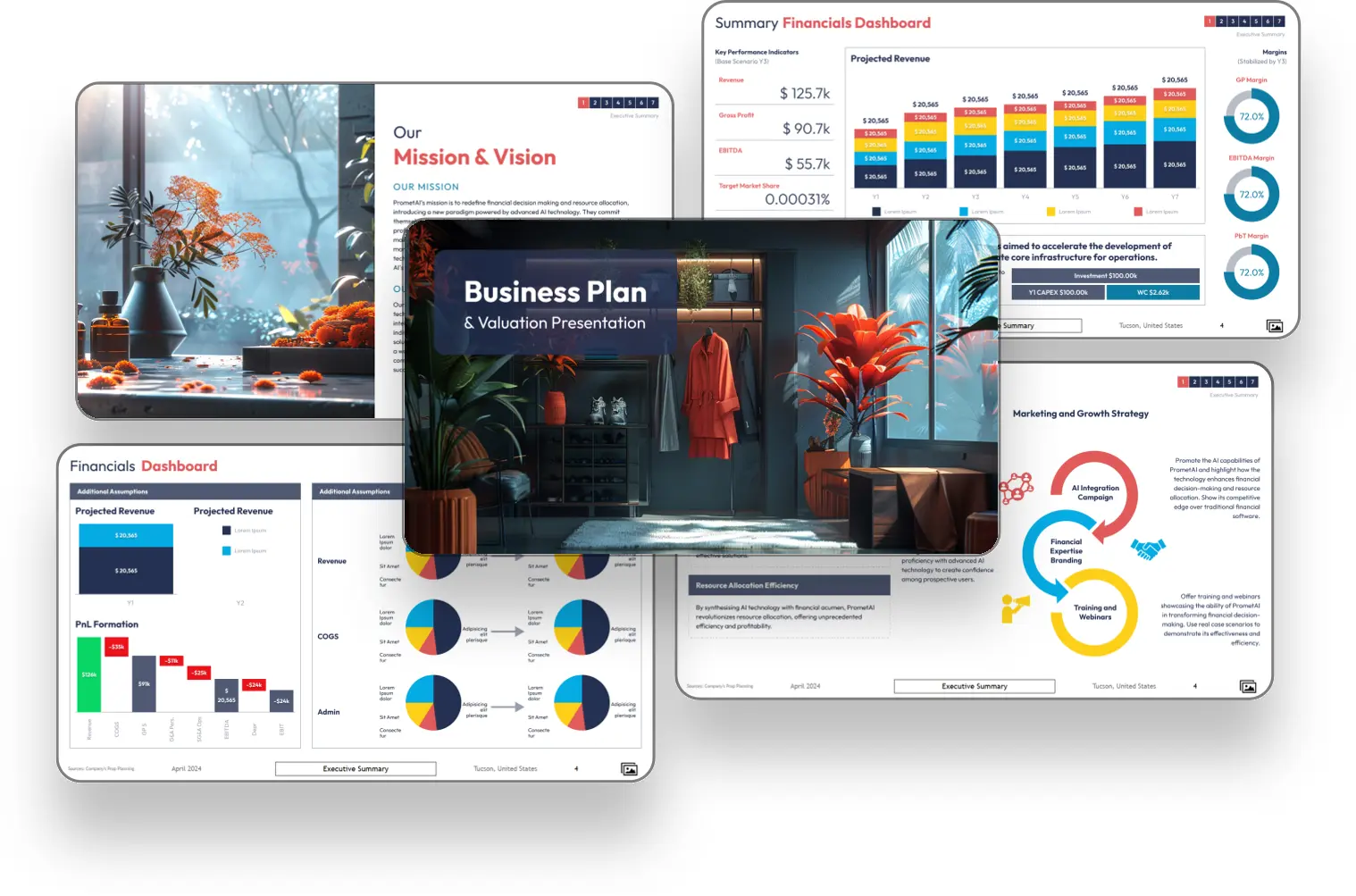
What You Get with PrometAI’s Loan Officer Business Plan Template

Executive summary

Executive summary

Market analysis

Market analysis

Revenue model

Revenue model

Cost Structure

Cost Structure

Financial projections

Financial projections

Funding strategy

Funding strategy

What Makes a Strong Business Plan
for a Loan Officer Business

Once you've picked your model, your loan officer business plan comes down to four simple numbers: how many people apply, how many get approved, how many of those approvals actually close, and how big each loan is on average. Every dollar of income comes from these four numbers. If you just guess a big total without showing how you got there, reviewers will notice. A mortgage loan officer business plan should show purchase loans and refinance loans separately, since they move in opposite directions when interest rates change.

The second thing reviewers look for is whether your business can survive ups and downs. This is hard, because loan volume can drop by half when rates change. A plan that only works in one type of market, with one type of loan, is describing a good year, not a real business. What keeps a business steady is its network of people sending it customers, like real estate agents, car dealers, accountants, and happy past borrowers. Name that network in your plan, and then be honest about the real risks tied to it, such as changing rates, borrowers who stop paying, rules about fair lending, and what happens if too many customers come from just a few sources.

The third thing is timing, and lending businesses need a lot done before they earn a single dollar. You need state licenses, a system for taking applications, a way to check documents, and rules to stay compliant, all before you accept your first application. That means costs build up early. A loan to help a first-time homebuyer moves at a different speed and earns different profit than a loan for business equipment or everyday expenses. A plan that shows the timeline for each loan type separately will have a much more believable market share than one that assumes every type of loan grows the same way everywhere.

After that, reviewers look for what could go wrong, and in lending there are two main risks: fewer loans get made when rates go up, and more loans fail to get repaid when the economy slows down. In a bad year, both can happen at once. A strong plan shows that the business can survive a sudden rate increase, adjusts its expectations for loan losses as the economy changes, keeps savings on hand to cover costs during a slow period, and rolls out new loan products in a smart, gradual order.

What Makes a Strong Business Plan

Financial Planning Considerations
for a Loan Origination Business

Making the same number of loans doesn't mean making the same amount of money. What matters is how much profit is left after costs, how many applicants actually get approved and follow through, and how many loans don't get paid back.

A good mortgage loan officer business plan template tracks all of this clearly, following one loan from start to finish so you can see exactly where the money goes.

Revenue mix and the spread

Revenue mix and the spread

Some money comes in right away, like a fee paid when a loan closes. Other money comes in slowly, a little at a time, like interest. Mixing these two together makes it hard to see how fast money is really coming in, and how risky it is.

Pull-through and cost per funded loan

Pull-through and cost per funded loan

Not everyone who applies for a loan ends up getting one, and not everyone approved goes through with it. What matters isn't how many people applied. It's how many made it through the whole process, and how much it cost to reach each one.

Credit losses as a modeled line

Credit losses as a modeled line

Some borrowers won't pay back what they owe. Smart lenders expect this and plan for it ahead of time, instead of being surprised by it later.

Cost of funds and warehouse capacity

Cost of funds and warehouse capacity

A lender often has to borrow money before it can lend money out. What that borrowed money costs decides how much the lender can lend, and how much profit is left over.

Licensing, compliance, and platform spend

Licensing, compliance, and platform spend

Before a lending business can take its first application, it needs permission to operate, safety rules to follow, and systems to manage everything. These costs start early, and grow as the business grows.

Common Mistakes in
Loan Officer Business Plans

01

Guessing the number of loans without showing the math

Saying "we'll make 50 loans a month" without explaining how is not a real plan, it's a guess. A good plan shows the full path: how many people find out about the business, how many apply, how many get approved, and how many of those actually go through with the loan. Only then does the final number make sense.

02

Using the same loss rate for all three years

If a plan assumes the same amount of unpaid loans for all three years of its projections, it shows there's no real thinking about how the economy changes over time. Loan losses should shift based on the type of borrowers and the economic conditions being planned for.

03

Assuming interest rates will never change

A plan built only around today's interest rates is risky, because rates don't stay still. When rates go up, fewer people want to refinance their homes, and fewer people can afford to buy one. A strong plan also shows what would happen if rates moved up or down by two percentage points, so it's ready either way.

04

Mixing up broker and lender numbers

There's a big difference between earning a small fee for connecting a borrower to a lender, and lending your own money and earning interest on it over time. These are two different businesses, with different risks and different ways of making money. If a plan mixes these two together, even without meaning to, it becomes very hard for anyone to trust the numbers.

05

Treating rules and compliance as a one-time task

Getting licensed isn't something you do once and forget about. It has to be renewed and reviewed every year, and it takes more work every time the business grows into a new state. A business plan for loan officer roles should budget for licensing every year, not just once. Skipping that shows the founder hasn't actually gone through the real process before.

06

Missing what investors look for

A plan that just says "this business will be profitable," with no details, doesn't give an investor much to go on. Investors want clear dates for each step, someone responsible for handling each risk, a spending plan, and honest answers for what happens if things don't go as expected. Without all of that, a plan is just a short summary, not something serious investors can actually question and trust.

Why Founders Use PrometAI to Build
Their Loan Officer Business Plan

Lending is one of the few businesses where the money you earn, the risk you take, and the rules you follow all connect to each other. Price a loan without thinking about losses, and the profit isn't real. Plan for losses without thinking about how many loans you'll actually close, and the loss number isn't real either. Trying to manage all three by hand, especially while making changes, is how plans end up contradicting themselves. PrometAI's AI business plan generator keeps the plan and the numbers built on the same set of assumptions, so nothing gets out of sync.

The built-in structure does real work here. Things like a map of who's involved (investors and regulators), a clear owner for each risk, and a dated plan for staying compliant are what separate a serious business plan from a rough idea. The financial model has to match these details exactly, not sit off in a separate document.

Then there's the interest rate question, which comes up in almost every meeting. If the cost of borrowing money changes, if loan volume drops by 20%, if losses double, or if a new product gets delayed, the whole plan needs to update itself, numbers and all. Being able to answer these "what if" questions on the spot is what helps a lender through a competitive analysis conversation. It's also the difference between a loan officer business plan worksheet that just looks nice, and one that actually holds up to scrutiny.

Why Founders Use PrometAI to Build

Example Structure of a Loan Officer Business Plan

Here's how the ClearPath Lending plan and valuation deck in this template is put together, section by section. Each note explains why this section matters to reviewers in the lending industry, and every example stays true to what's actually in the deck.

Sections

1. Executive Overview (Mission, Vision & Business Concept)

2. Company Overview & Product Offering

3. Market Opportunity & Target Customers

4. Growth Strategy & Development Phases

5. Competitive Positioning & Strategic Analysis

6. Operations & Organizational Structure

7. Financial Overview (Revenue Model, Investment & Key Metrics)

8. Risk Management & Compliance Considerations

9. Scenario Analysis, Stress Testing & Financial Simulations

Read More

FAQs