SaaS Business Plan Template

A SaaS business plan template should do more than just organize information. It should clearly explain how recurring revenue grows, how much it costs to acquire customers, and how the product can stay competitive as the market becomes more crowded.

At the same time, for any SaaS company, having a well-structured plan makes it easier to turn an idea into something investors can understand and trust. It brings together key elements such as market timing, pricing, customer retention, and funding needs, creating a clear flow that supports better and more confident decision-making.
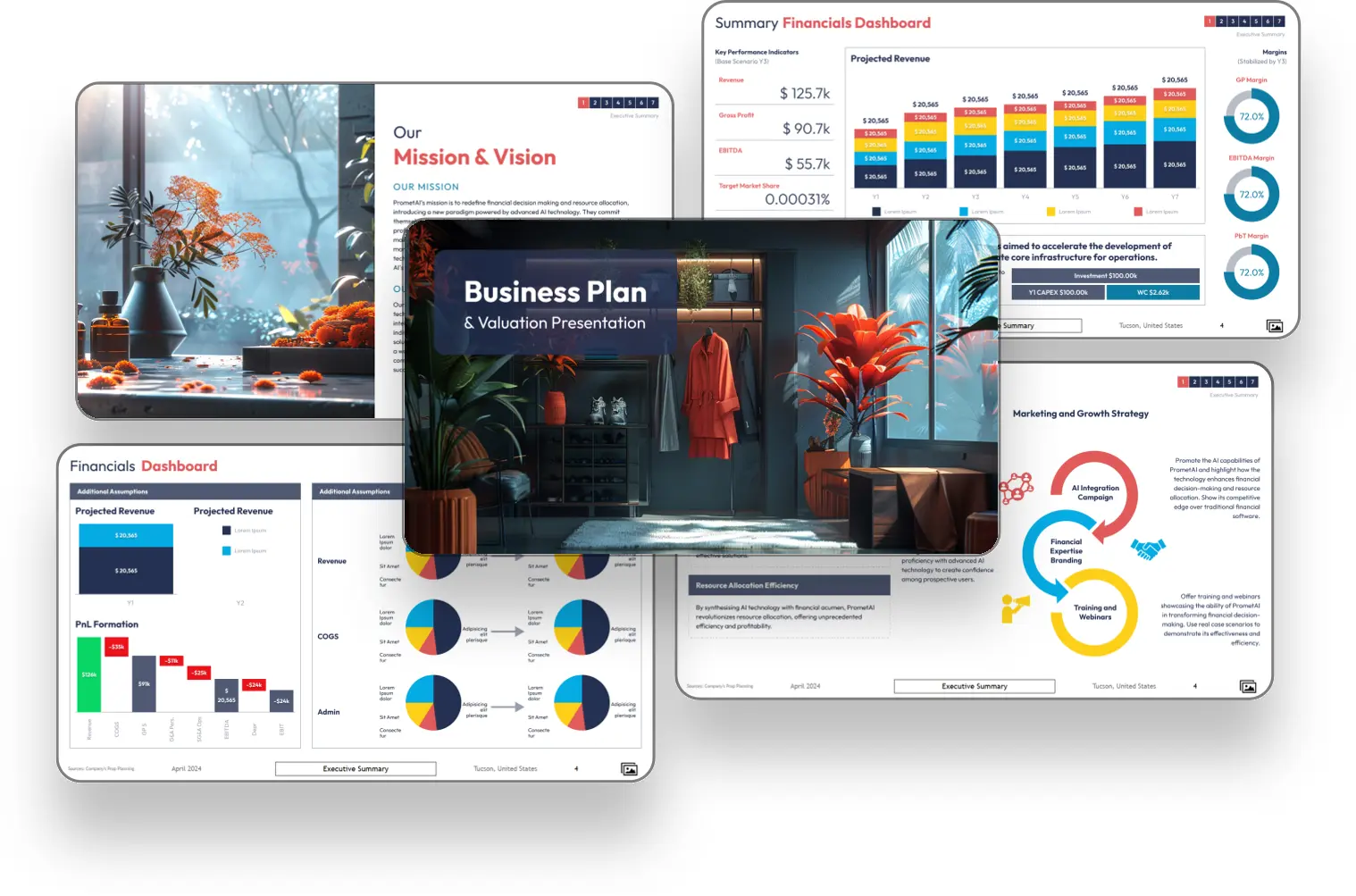
What You Get with PrometAI's SaaS Business Plan Template PDF

Executive summary

Executive summary

Market analysis

Market analysis

Revenue model

Revenue model

Cost Structure

Cost Structure

Financial projections

Financial projections

Funding strategy

Funding strategy

Risk analysis

Risk analysis

Production planning

Production planning

What Makes a Strong
Business Plan for a SaaS Startup

In the SaaS business, investors want more than just a good idea. They look for clear signs that the business can attract customers at a reasonable cost, keep them over time, and grow revenue without costs increasing too quickly.

A strong plan, often supported by a saas business model template, explains things in a simple and logical way. It clearly shows what the product does, who it is built for, and how it will reach the market. It also explains why the product solves a specific problem better than other options, how it will compete with existing tools, and how pricing fits customer expectations. Important factors like ease of use, switching effort, integrations, and long-term stability are also part of the picture.

At the same time, the plan should stay realistic about growth. It should outline clear sales timelines, onboarding limits, support needs, and product development priorities. Revenue growth should be linked to how customers actually behave. Areas like compliance, data handling, security, and system integration should be addressed early, so they are treated as key parts of the plan, not small details later.

Business Plan for a SaaS Startup

Financial Planning Considerations
for a SaaS Business

Strategic financial planning is a key part of any saas business model. In software, it is not only about growing revenue. It is about showing how recurring revenue works and how stable it is over time. A strong plan should connect the product with customer retention, revenue growth, support needs, and how capital will be used in a clear and realistic way.

Working capital and funding timing

Working capital and funding timing

Even in a saas business model, careful cash planning is needed. Funds are required for product development, go-to-market efforts, and daily operations before recurring revenue becomes stable.

Hosting and support cost structure

Hosting and support cost structure

Costs should include infrastructure, support, maintenance, and product updates. This gives a clear and realistic view of margins.

Retention and expansion dynamics

Retention and expansion dynamics

The value of a SaaS business depends on customer churn, renewals, and how accounts grow over time. This includes upgrades, increased usage, and expansion within existing customers.

Customer acquisition payback

Customer acquisition payback

Growth should be linked to how efficiently customers are acquired. It should show conversion timing and how long it takes to recover acquisition costs, instead of assuming revenue comes in right away.

Recurring revenue mix

Recurring revenue mix

Revenue should be clearly split between subscriptions and non-recurring income like onboarding, implementation, or services. This makes it easier to understand the quality of revenue.

Common Mistakes in
SaaS Business Plans

01

Overstated growth curve

Some plans assume customers will grow very quickly without considering real sales timelines, onboarding limits, or delays in implementation.

05

Investor-readiness gaps

Many plans explain the product well but miss key points like pricing structure, customer retention, market entry steps, and how the business will handle risks.

04

Underbuilt capital plan

Some founders do not plan enough cash to reach steady recurring revenue, especially when early costs for product and customer acquisition are high.

03

Confused revenue quality

Mixing subscription revenue with one-time fees or services can make the business seem more scalable than it really is.

02

Weak margin logic

Gross profit is often shown too high because real costs like support, hosting, integrations, and service work are not fully included.

Why Founders Use PrometAI to
Build Their SaaS Business Plan

Many founders choose PrometAI because it brings clear structure to a Saas company business model from the start. It connects strategy, financial assumptions, and the overall story into one plan, so everything flows together the way investors expect to see it.

What makes it even more useful is how it handles financial planning. PrometAI helps with automated forecasting, valuation, scenario analysis, and stress testing, so ideas can be checked instead of just written. This makes it easier to build a plan where revenue, costs, funding needs, and risks are clearly connected, easy to test, and simple to use for decision-making.

Why Founders Use PrometAI to

Example Structure of a SaaS Business Plan

A saas business plan example follows a clear and simple structure where each section connects to the next. This makes the full plan easy to read and understand from start to finish. A well-prepared saas business plan sample keeps everything organized and easy to follow.

Sections

1. Executive Overview (Mission, Vision & Business Concept)

9. Scenario Analysis, Stress Testing & Financial Simulations

8. Risk Management & Compliance Considerations

7. Financial Overview (Revenue Model, Investment & Key Metrics)

6. Operations & Organizational Structure

5. Competitive Positioning & Strategic Analysis

4. Growth Strategy & Development Phases

3. Market Opportunity & Target Customers

2. Company Overview & Product Offering

Read More

FAQs