Grocery Store Business Plan Template

A grocery store handles a great deal of money and keeps very little of it. In the model behind this page, 70 cents of every dollar of sales goes on stock, store wages, spoilage, and other direct costs before the rent is paid, and 12.5 cents survives as EBITDA. Shrink and spoilage alone take 6 cents, almost half of what remains. A grocery store business plan template is worth using if it shows how thin that remainder is and which lines move it.

Marlowe Street Market, the worked example supplied here, is a 9,000-square-foot independent grocery in a dense residential neighbourhood. It sells produce, meat and dairy, packaged groceries, deli meals, and beer and wine, and takes online orders for pickup and local delivery. The deck describes the departments and the waste risk well. Its sales, wages, and rent are small for a store of that size, and the sections below show how to rebuild each one.

Business Plan Template Example

What You Get with PrometAI's Grocery Store Business Plan Template

Executive summary

Executive summary

Market analysis

Market analysis

Revenue model

Revenue model

Cost Structure

Cost Structure

Financial projections

Financial projections

Funding strategy

Funding strategy

Risk analysis

Risk analysis

Production planning

Production planning

What Makes a Strong
Business Plan for a Grocery Store

Begin with what each department keeps. Packaged groceries sell at prices shoppers can compare on their phones, so the margin is thin and steady. Produce, meat and dairy earn more on each sale and lose more to spoilage. A deli turns ingredients into sandwiches and hot meals and carries labour of its own. Marlowe's overview says as much, yet the model applies one purchase ratio, 50 percent of sales, to all four lines. A business plan for a grocery store should give each department its own cost of goods, its own shrink allowance and its own share of the floor, so a lender can see which aisles pay for the building.

Then explain where the stock comes from and on what terms. An independent store usually buys most lines from a main wholesaler, some from vendors who deliver and merchandise their own products, and in Marlowe's case fresh goods from nearby producers, whose freshness is the store's main argument against the chains. Set out these partnerships with local suppliers, their minimum orders, delivery days and payment terms, because each one decides how much stock sits in the back room and how much cash it ties up. The deck's risk table names dependence on supplier terms and price volatility. The plan should say what happens to margin if the main wholesaler raises prices.

Third, show why neighbours will choose this store over a bigger one. Marlowe faces chains, club stores, specialty shops and online grocery delivery. A small grocery store business plan rarely wins on the price of a full weekly basket; it wins on distance, freshness, opening hours and the deli. Map every store within walking distance or a short drive in a competitive analysis, note their hours and what they do not stock, and name the trips the store expects to capture: the daily top-up, the lunchtime sandwich, the bottle of wine on the way home.

Fourth, cost the licences and the build in full. Beer and wine need a licence and staff trained to check ID. The deli needs a food-safety plan and passes inspections. Refrigeration needs maintenance contracts and a plan for power cuts, because a failed cooler can spoil a week of stock overnight. Each of these belongs in the estimate of startup costs and in the register of financial risks, with an owner and a response. Marlowe's deck already lists food safety, allergen labelling and alcohol compliance as risks; the financial section should carry the costs that go with them.
What Makes a Strong

Financial Planning Considerations
for a Grocery Store

A grocery store is a high-volume, low-margin business in which small percentages become large sums. Five points in the Marlowe model decide whether the plan will stand up, and the first two concern how little room there is.

Seventy cents goes before the rent

Seventy cents goes before the rent

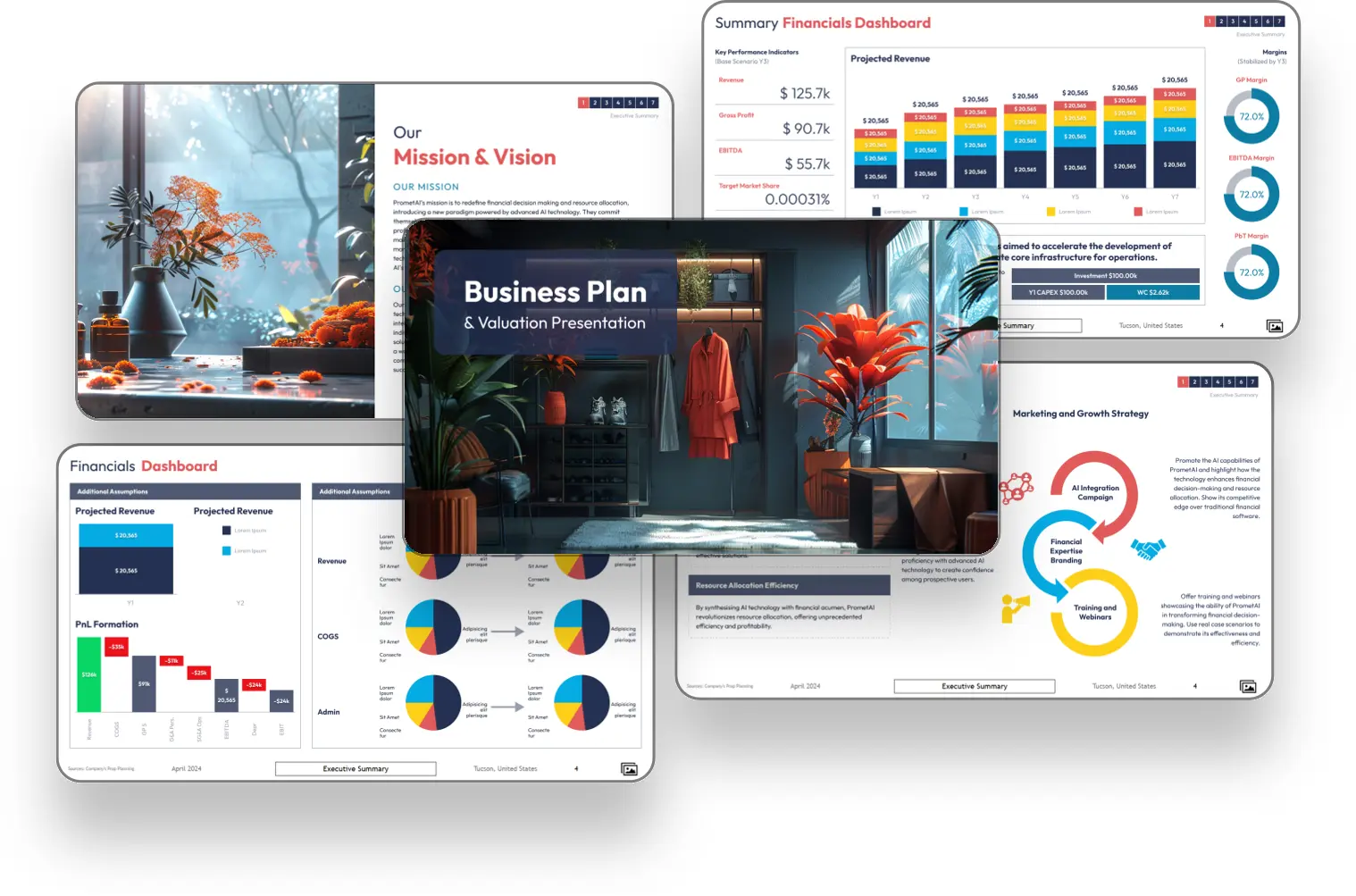
Direct costs take 70 percent of sales in every year of the deck: stock at 50 percent, store wages at 12, shrink and spoilage at 6 and other items at 2. Gross profit comes to $239k, $373k and $452k, and EBITDA to $100k, $155k and $189k. That structure works in both directions. In the deck's own scenario test, cutting direct costs by a fifth lifts Year 3 EBITDA to $400k, while raising them by a fifth produces a $23k loss. A supplier price rise that cannot be passed to shoppers is the first risk to plan for.

Shrink costs almost half the profit

Shrink costs almost half the profit

The model shows shrink and spoilage as a line of its own, $48k in Year 1 and $90k by Year 3. That equals close to half of EBITDA every year, and each percentage point of shrink is worth about $15k at Year 3 sales. The rate stays at 6 percent throughout, although the roadmap includes a waste-reduction programme. Split shrink into spoilage by department and theft, set a target for each year, and show what the programme costs beside the saving it should bring.

Nine thousand square feet can sell more

Nine thousand square feet can sell more

First-year revenue of $797k is about $89 of sales per square foot, or roughly $2,200 a day. By Year 3 the store sells $1,508k, about $4,100 a day. These figures are a share of the national grocery market rather than a count of the store's own customers. Build sales from the ground up instead: transactions a day, average basket, online orders and deli tickets, rising over the opening months. Compare the result per square foot with published trade figures for stores of this size before a lender does.

Wages and rent follow sales in the model

Wages and rent follow sales in the model

Payroll is set at 12 percent of sales in direct costs and 7 percent in overheads, $152k in Year 1, or about $2,900 a week. That has to staff the tills, the deli counter, deliveries in and out, shelf filling and online order picking on every trading day. Rent and utilities are 4.5 percent, or $36k, about $4 a square foot a year including the power for the coolers. Rebuild wages from a staffing rota at local pay rates, enter the quoted lease as a fixed monthly sum, and add a line for delivery. Expect the 12.5 percent EBITDA margin to narrow.

The till pays today and suppliers wait

The till pays today and suppliers wait

Shoppers pay at the checkout and card payments settle within days. The deck assumes customers pay in 30 days, so it shows $83k of receivables at the end of Year 1 and operating cash flow of minus $38k in a year with $100k of EBITDA. It also records only $4k owed to suppliers. Set receivables to card settlement times and payables to the terms agreed with each wholesaler, and value stock at purchase cost by department. The cash forecast will change, usually for the better, and it will be easier to defend.

Common Mistakes in
Grocery Store Business Plans

01

One margin for the whole store

A blended margin hides which departments lose money. Give produce, meat and dairy, packaged goods, the deli, and beer and wine their own cost of goods and shrink rate.

02

Treating shrink as a constant

Spoilage and theft respond to ordering, rotation and security. A plan that holds shrink flat cannot show what its own waste programme is worth.

03

Charging rent as a share of sales

The landlord is paid the same in a quiet month as in a busy one. Model the lease as a fixed cost and show the sales needed to cover it.

04

Setting wages as a percentage

Count the people needed for each department and each opening hour, then price them. A rota is the only defensible basis for the largest cost after stock.

05

Leaving delivery and card fees uncosted

Online orders cost money to pick, pack and drive, and card fees apply to nearly every sale. Give each its own line rather than folding them into other costs.

06

Forgetting the opening stock

A 9,000 square foot store has to be full on the first morning. Price the opening inventory by department and include it in the funding request beside the coolers and shelving.

Why Founders Use PrometAI to
Build Their Grocery Store Business Plan

Grocery numbers are tightly linked. Give the deli a larger share of sales and gross margin shifts, and so do labour and spoilage. Open an hour longer and wages rise before sales do. Widen the delivery area and orders grow along with driving costs. PrometAI draws all three financial statements from a single set of inputs, so a change to one department's margin or one supplier's terms reaches profit and cash together.

That makes it possible to answer a lender's questions before the meeting. What happens if the main wholesaler raises prices? What is two points less shrink worth? Marlowe's deck gives the range: from a base valuation of $666k, sales 15 percent higher give $774k and direct costs a fifth lower give $1,471k, while direct costs a fifth higher push the figure below zero. The way the three statements connect is covered in our guide to building a startup financial model.

Banks, landlords and equipment lenders receive the plan in the order they read it, with a named owner beside every risk and a valuation that shows its 12.28 percent discount rate. When weighing up AI business plan tools, check that each department can carry its own margin and that rent can be entered as a fixed amount, because those two settings decide whether a grocery forecast is believed.

Why Founders Use PrometAI to

Example Structure of a Grocery Store Business Plan

A lender reviewing a grocery store will usually look for the nine sections below. Each has a short note and an example taken from the Marlowe Street Market deck, one of the grocery store business plan examples available to download as a PDF.

Sections

1. Executive Summary

2. Company Description

3. Market Analysis

4. Departments and Pricing

5. Marketing and Loyalty

6. Operations, Sourcing and Waste

7. Financial Projections

8. Funding Request

9. Risk Analysis and Valuation

FAQs