"Use Lean Canvas if you're a startup. Use Business Model Canvas if you're an established company." You've probably heard some version of that rule. It's the standard answer, repeated in almost every guide on the topic. It's also wrong, or at least incomplete enough to lead a lot of founders astray.
6 min
Lean Canvas vs Business Model Canvas: Which to Use
15 September 2026
)
Both tools have serious scale behind them, which is exactly why this comparison matters. The Business Model Canvas is used by more than 200,000 companies, including Microsoft, Coca-Cola, Nestlé, MasterCard, Sony, and 3M. Lean Canvas, meanwhile, is used by over a million entrepreneurs, accelerators, and universities, including MassChallenge and Techstars.
So the real question isn't which one is more popular. It's which one actually solves the problem sitting in front of you.
Key Takeaways
Lean Canvas isn't a new invention. Ash Maurya took the original Business Model Canvas and swapped out four of its nine boxes.
Those four boxes shifted the focus. Questions about delivering a product got replaced with questions about whether anyone actually wants it.
Company age was never the real sorting rule. What actually separates these tools is which end of the business is more likely to be wrong: the demand side, or the delivery side.
The real test isn't "startup or established." It's naming your riskiest assumption first, then picking the canvas built to interrogate it.
What Each Canvas Actually Contains
Popularity aside, the real difference lives inside the boxes themselves.
The Business Model Canvas — the Complete Map
The business model canvas was built as a strategic management tool.
It's meant to describe, design, challenge, invent, and pivot a business model as a whole system. It comes from the bestselling book Business Model Generation, by Alexander Osterwalder and Yves Pigneur.
It's used to visualize a business that already exists, to design brand new ones, to manage a whole portfolio of business models at once, and to help companies move between "exploring" new ideas and "exploiting" ones that already work.
200,000+ companies use the business model canvas today, including Microsoft, Coca-Cola, Nestlé, Mastercard, Sony, and 3M.
Looking at real business model canvas examples is one of the fastest ways to see this in practice.
For a full breakdown, here's the business model canvas, box by box.
The Lean Canvas — the Focused Instrument
The lean canvas came later, created by Ash Maurya in 2010.
It adapts Osterwalder's original canvas specifically for startups operating under extreme uncertainty. Instead of mapping a whole business, it's built for one job: identifying and testing your riskiest assumptions before you build anything at all.
1 million+ entrepreneurs, accelerators, and universities use the lean canvas, including MassChallenge and Techstars, plus hundreds of university programs coaching early-stage founders through validation.
Anyone starting from scratch usually reaches for a lean canvas template first, simply because it's built for speed.
If you like that one-page format, here's the case for a one-page business plan.
The Four Boxes That Were Deleted (and What Replaced Them)
Here's the part most comparisons skip entirely. Ash Maurya didn't invent a new canvas from scratch. He took the original Business Model Canvas and made a very specific trade.
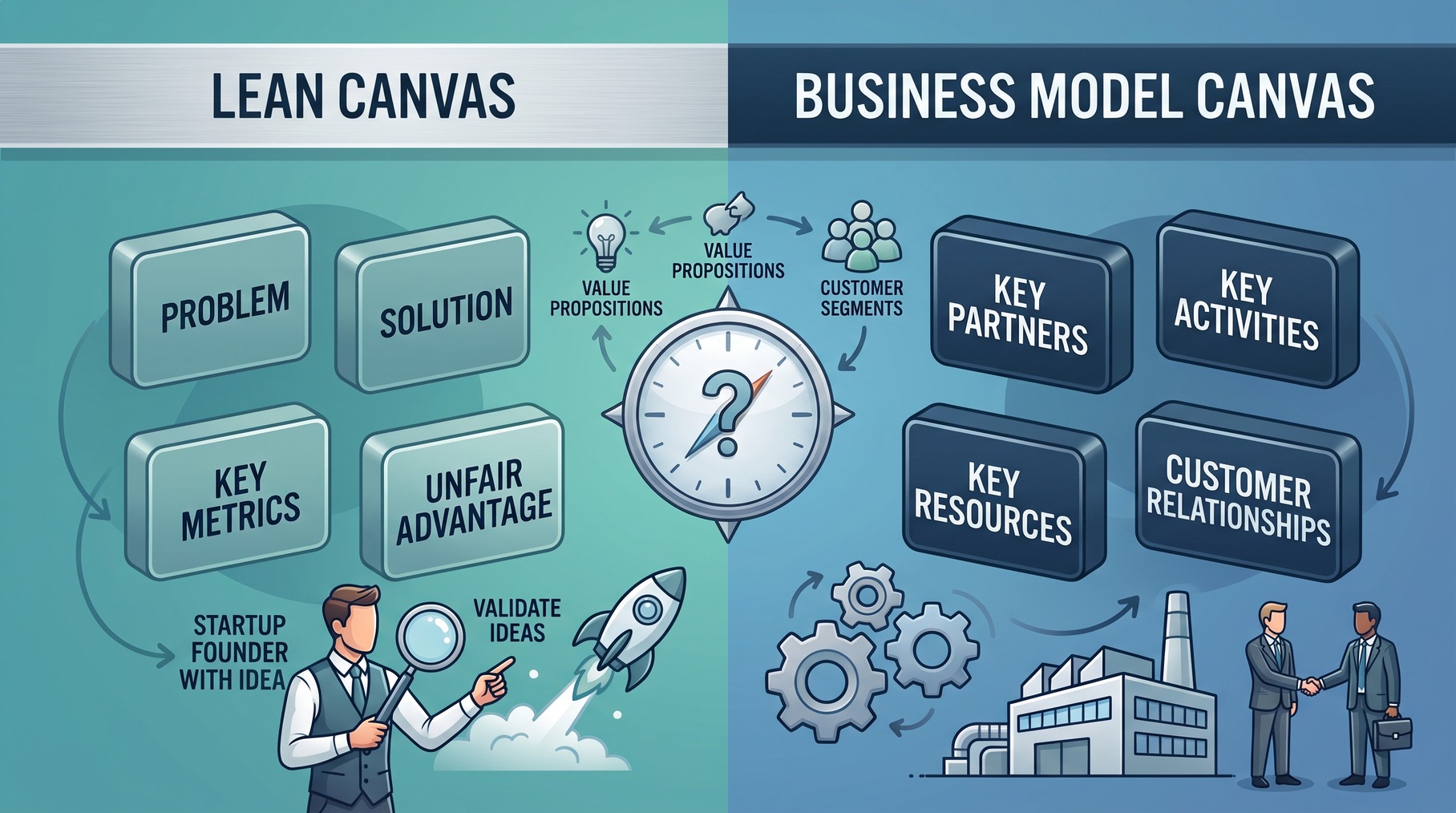
He removed four boxes: Key Partners, Key Activities, Key Resources, and Customer Relationships. In their place, he added four different ones: Problem, Solution, Key Metrics, and Unfair Advantage.
Look at the pattern here, because it's the whole story. Every box that got removed asks some version of "can we deliver this." Every box that got added asks some version of "does anyone actually want this." That's the core of the lean canvas vs business model canvas differences.
Maurya explained the logic behind this swap directly: early-stage ventures “need to understand their problem deeply before worrying about key partners.” They also “need to define metrics before cataloging resources.”
Key partners business model canvas planning is a delivery question, and Maurya's point is that it can wait. In other words, figuring out demand comes before figuring out delivery, at least when you're this early.
Quick pause: what's the single most likely reason your business fails in the next 12 months? “Nobody wants it” points to the four boxes Lean Canvas added. “We can't deliver this at a workable cost” points to the four boxes it removed.
Both sets of boxes still matter eventually. This really comes down to defining your value proposition before anything else, since that's the piece both canvases share, and the one Unfair Advantage was built to protect.
Neither Canvas Is a "Stage" Tool
Here's a common belief people have. Startups should use Lean Canvas. Everyone else should use Business Model Canvas. But this belief is wrong, and even the company behind Business Model Canvas says so.
Strategyzer, the company that created the Business Model Canvas, describes it as a tool for designing new business models "whether you are a start-up or an existing business." That's straight from them, word for word. Not something we're guessing at.
So a company's age was never really the rule that decides which canvas to use. Let's see why with some real examples.
Imagine five different brand new companies: a marketplace, a hardware company, a medical clinic that needs special licenses, a shipping company and an insurance company.
All of them are technically "startups." But in every single one of these, the scariest unknown usually isn't whether people want the product. It's something else. Can we actually get the parts we need? Can we make this cheaply enough? Can we get the right licenses? Has our important partner even said yes yet?
These are all questions about Key Partners, Key Activities, and Key Resources, the exact boxes Lean Canvas removed.
If a founder in one of these situations picks Lean Canvas just because "that's what startups are supposed to use," they're not actually lowering their risk. They're hiding their biggest risk behind the wrong tool.
This is really the whole point of the lean canvas vs business model canvas question, and the business model canvas vs lean canvas comparison in general. It was never about how old your company is.
To understand this even better, here's business model vs. business plan.
Choose by Risk, Not by Identity
Here's a simple two-step way to actually decide between these two canvases, instead of just guessing.
Fix #1: Figure out what could kill your business.
Write down one sentence. What has to be true for your business to survive? If that one thing turns out false, does everything fall apart?
Now check both canvases. Which one has a box that matches that exact worry? If Lean Canvas has it, use Lean Canvas. If Business Model Canvas has it, use that one instead.
And here's a helpful shortcut: if both canvases happen to have a box for it, it genuinely doesn't matter which one you pick. Stop worrying about the choice and just get started.
Fix #2: Treat your canvas like a photo, not a stone carving.
Ash Maurya himself gives good advice here. Think of each canvas as a photo of what you believe right now, today. Write today's date on it. As you learn new things, make a brand new version instead of erasing the old one.
In practice, that means picking your riskiest box, giving someone the job of testing it, and setting a real deadline for that test. Then come back and check the whole canvas again on a regular schedule, not just whenever you happen to remember.
Here's the thing about untested guesses. They don't just disappear because you're not looking at them. They sit there quietly, waiting to surprise you at the worst possible moment.
If you want extra help managing this the right way, here's managing startup risk systematically.
Conclusion
One canvas describes a business that already works. The other is a list of guesses waiting to be tested. That's really the whole lean canvas vs business model canvas story.
Mix the two up, and you'll either plan a business with no real customers, or spend months proving people want something you can't actually build.
Here's the one thing to do. Find the biggest unknown, the thing that could break your business if you're wrong about it. Then pick whichever canvas has a box for that exact thing.
Once you fill it in, don't treat it like a finished paper. Treat it like a list of risks you still need to check off, one by one.
FAQs
Related articles
)
How to Start a Jewelry Business
)
SBA Loan Denied? What To Do Next and How to Appeal It
)
SBA Loan Business Plan Guide: What Lenders Actually Want
)
Business Intelligence Tools: How to Choose the Right Platform
)
I Want to Start a Business But Have No Ideas: 3 Ways to Find One
)
Lean Business Plan Guide: The Monthly Review Cycle Explained
)
How to Start a Dental Practice
)
Can ChatGPT or Claude Write a Business Plan? Honest 2026 Test
)
Grammarly Business Plan Generator: What It Really Makes (2026)
)