Anyone looking into how to start a pizza shop already knows that some foods come and go. Pizza never does. It shows up at birthdays, game nights, late-night cravings, and every Friday dinner in between. People will always want it, and that is exactly why so many dream of opening their own shop.
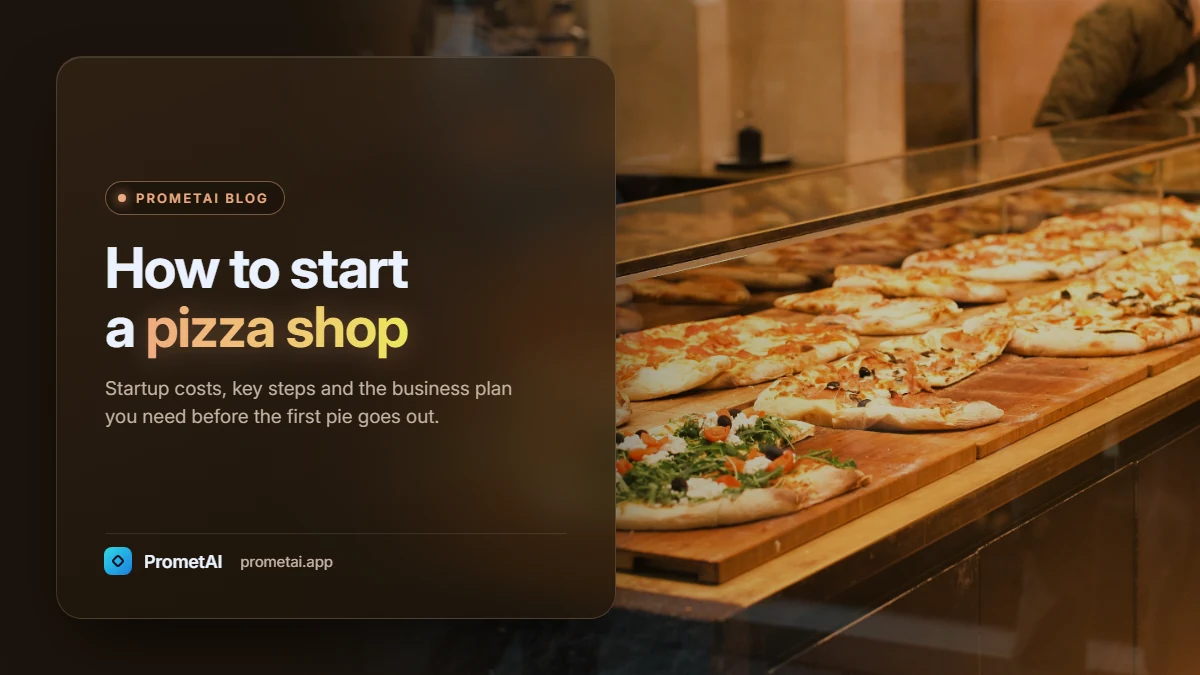
How to Start a Pizza Shop
24 October 2026
Overview
💰 Startup Economics
- Startup Cost
$95,000 – $300,000 (takeout and delivery storefront); $175,000 – $750,000 (dine-in pizzeria)
- Gross Profit Margins
5–10%
- Break-even Point
9–18 months, driven by weekend order volume and format choice
- Funding Options
SBA 7(a) loans, equipment financing, landlord improvement allowance, equipment leasing, personal savings
📅 Timeline Overview
🏷️ Phase / 📍Months
1-2
3-7
8-10
11-15
🧠 Concept, Licensing & Site Search
🛠️ Lease, Build-Out & Oven Install
🛍️ Hiring, Menu Testing & Promotion
🚀 Launch & Iterate
🌐 Industry Snapshot
- Market Size

- $49.6 billion U.S. pizza restaurant revenue (2025)
- Growth Trend
 -0.3%
- 75,736 pizzerias operating nationwide


🔥 Hot Segments
Carryout-led neighbourhood shops
Delivery-only ghost kitchens
Detroit and Sicilian square styles
Par-baked and take-and-bake
Late-night and event catering
Here is the secret behind a great pizza shop: the pizza is the easy part. Flour, water, tomato, and cheese. Everyone knows what it should taste like, and everyone already knows what they want before they open the menu.
The hard part is the choice behind the counter. Will your customers pick up their pizza, or sit down and eat it? A takeout counter keeps costs low, and you will often work the oven yourself. A dine-in pizzeria adds seating, staff, and a license to match.
Choose one, and build your costs around it from day one. The shops, still busy after five years, all did that. They picked a single way to reach their customers, and they gave it everything.
Inside the Business of Pizza: What a Pizza Shop Is and Why It’s Worth Starting?
So, what exactly is a pizza shop? It’s a place that makes and sells pizza for carryout, delivery, dine-in, or a mix of these. Most shops also offer a short menu of sides, salads, and drinks.
This is different from a general fast food restaurant. A fast food restaurant competes on a wide menu and quick assembly. A pizza shop competes on one product, made the same way every time, and on how reliably it arrives hot.
Most owners start with a single counter. Some grow to several neighborhood shops. Others add a second delivery-only brand, cooked on the same equipment.

Why Start a Pizza Shop?
Ingredients are cheap compared to the price customers pay
Orders come in predictable weekend rushes
One main product makes training and prep much easier
Carryout needs no drivers and no delivery app fees
The same equipment can power a second delivery brand
Now, let’s look at the numbers. The business of pizza is big, but it is not growing right now. In 2025, U.S. pizza restaurants earned $49.6 billion, a drop of 0.3% from the year before. That money is spread across 75,736 pizzerias.
So what does this mean for you? The market will not hand you extra profit. You make it inside your shop.
That is why three things matter most. The first is food cost, which usually runs 25% to 35% of sales, depending on your menu and the quality of your ingredients. The second is labor, which takes 23% to 28% of sales in most pizzerias. The third is your channel mix, meaning how much you sell through carryout, delivery, and dine-in, because it shapes both of the other two.
Plan Your Pizzeria: Shape and Refine Your Ideas
Most people plan a pizzeria by picking the pizza first. The smartest owners do the opposite. They start with three questions. How much rent can I carry? Who can I staff on a packed Friday night? And how do people here like to get their dinner?
Answer those honestly, and your concept almost designs itself.
Now it’s time to get specific. Before you sign anything, think through these:
Am I building for carryout, delivery, dine-in, or a planned mix?
Which pizza style will I make, and can I make it fast when the shop is full?
Does my site need a hood and three-phase power, and how much will that cost?
Will I use my own drivers, delivery apps, or no delivery at all?
Still unsure? Good, that means you’re thinking carefully. The two brainstorming methods below are made for exactly this moment. They help you look at your idea from angles you may have missed.
Once you’ve explored your angles, pick one idea you’re most drawn to—it doesn’t have to be perfect, just clear enough to build on. In the next section, we’ll help you see if this business fits your skills, lifestyle, and goals.
By the way, once you’ve defined your vision, you can also generate a professional financial advisor company name using our . It’s a quick way to get inspired and see what fits your brand.
Now look at both tables and pick the format your rent and your local workers can truly support.
Here is the trap to avoid. Many new owners try to run a dine-in restaurant, a delivery business, and a carryout counter all at once. Then they pay the costs of all three.
Once your format is clear, there is one more thing to check: does running a pizza shop truly fit your strengths and the lifestyle you want? Let’s find out.
Should You Start a Pizza Shop? Is It Right for You?
Starting a pizza shop has a lot going for it. Ingredients are cheap. Demand is already there. And the people in your neighborhood can become loyal customers for years.
But there is another side. Your busiest nights are Friday and Saturday, exactly when everyone else is out having fun. Your kitchen runs hottest at that moment. And even a very busy week can leave you with a small profit.
So before you jump in, ask yourself one simple question: does this life fit me?
Here is a quick self-check. If most of these feel true for you, you are on the right track.
Checklist Item
I have been prepared to work Friday and Saturday nights for years.
I can hold food costs within a few points month after month.
I can staff and run a kitchen at full tilt for four hours.
I understand what delivery actually costs me before any platform commission.
I can build a local reputation without a national ad budget.
I accept that a busy trading week can still yield single-digit margins.
🔁 Boxes checked: 0 out of 6
Ready to find out if this business suits you? Start checking the boxes above. We'll show you insights as soon as you interact with the checklist.
Somewhere in the middle? That’s normal. It means you have real interest, with a few gaps to fill. Think about where you will need extra help and support.
Being honest with yourself now saves you from bigger problems after opening day. If you are still excited, that is a great sign. Next, let’s decide what you will offer, and who you are building it for.
Define Your Resort Services Offered
Your Audience
Great pizza shops start with one question: who is going to eat here? Most customers fall into four groups.
Weekend Family Orders: Families buying two or three pizzas at once. They want good value per person and a shop they can trust every time.
Carryout Regulars: Locals who live close by. They order the same thing every week, and they won’t pay a delivery fee.
Late-Night Customers: Few places stay open late, so there is little competition. Orders are often bigger, but you will need a different team for these hours.
Office and Event Buyers: People who place big orders in advance on weekdays. These orders fill the quietest hours of your week.
What You Might Sell
Now that you know your customers, let’s build your menu. Start with the basics, then add extras that earn more.
Core Products
Signature house pizzas
Build-your-own base options
Slices at lunchtime
Signature Elements
A dough recipe nobody nearby can match
A pizza style your neighborhood can’t get anywhere else
Steady timing on every weekend order
Add-ons & Upsells
Wings, garlic bread, and sides
Premium toppings and larger sizes
Desserts and bottled drinks
Ancillary Opportunities
Catering trays for offices and events
Take-and-bake pizzas for the freezer
A second delivery-only brand on the same oven
A good menu gets customers in the door once. So how do you get them back? Offer a loyalty program for frequent orders, standing weekly orders for regulars, and prepaid family bundles.
Here is why this works. Your ingredients are cheap and each order is fairly small. So one extra order from each customer every month is worth more than a price increase.
How You'll Deliver
Your menu is ready. Now, how will the pizza reach your customers? You have three choices.
Carryout-Led Model: Customers come to you. That means no drivers, no commissions, and no delivery insurance. The trade-off is fewer customers in your area.
Own-Delivery Model: You hire drivers and keep the customer relationship. In return, you pay for vehicles and insurance, and your labor cost is much higher.
Platform Delivery Model: A delivery app brings the food to the door, but it also owns the customer. It takes a commission on every order it sends you.
Whichever you choose, a few simple tools can make every day easier:
Online ordering that skips platform commissions
Kitchen screens that follow your oven timing
Dough made ahead, based on weekend forecasts
Weekly stock counts checked against what you actually sold
Summary
You’ve now seen the whole picture, and it comes down to three questions. Who are your customers? What style are you known for? And how does the pizza get to them? Answer these, and every other choice gets much easier.
To make your answers clear, put them into one short sentence: “We serve [who] with [what], because they value [why].”
Here are a few examples:
We serve weekend families with large-format bundles, because they value feeding everyone for a fixed price.
We serve carryout regulars with a cheaper collected price, because they value not paying for delivery they do not need.
We serve late-night customers with a short menu after midnight, because they value somewhere still open.
Why does this one sentence matter? It keeps your branding focused, your menu simple, and every order speaking to the customer you want most.
Pros and Cons of Starting a Pizza Business
Every big decision has two sides, and starting a pizza business is no different. Before you commit, let’s look at the good and the bad, one at a time.
Pros
Ingredients cost little compared to the price of a family-sized order
Everyone already knows pizza, so you don’t need to teach customers to want it
One main product makes training simple
Carryout orders have no commission and no driver cost
The same oven can power a second brand
Cons
The whole pizza market is flat, so any growth has to come from taking customers from rivals
Delivery pushes your labor cost up by several points
Weekend rushes put most of your risk into just a few hours
Cheese and flour prices can change without warning
Even a busy shop keeps only a small profit
Still feeling excited after reading both lists? That is a great sign. Next, let’s look at what it really costs to get started, and what you could earn, the two numbers every business plan for pizza starts with.
Average Cost to Open a Pizza Shop, Revenue and Profit Margins
The average cost to open a pizza shop depends almost entirely on the format you choose. And the gap between formats is wider here than in most food businesses.
So let’s see the full cost of opening a pizza shop, and what you can earn.
Startup Costs
Opening a pizza shop usually costs between $95,000 and $750,000, depending on the model, the location, and the equipment.
The three formats are very different:
A delivery-only ghost kitchen can open for $10,000 to $60,000.
A takeout and delivery storefront costs $95,000 to $300,000.
A dine-in pizzeria costs $175,000 to $750,000.
One more big cost is the oven. It can run from $5,000 to over $100,000, depending on whether you choose a conveyor, deck, or wood-fired oven.
Cost Breakdown
So where does the money go? The table below shows a takeout and delivery storefront of about 1,200 to 1,800 square feet in a leased retail space.
A ghost kitchen skips most of these costs. A dine-in pizzeria adds seating, restrooms, and a customer area to build.
Category | Range | Notes |
Lease Deposit & Legal | $8,000 – $16,000 | Deposit, first period rent, lease review |
Build-Out & Ventilation | $40,000 – $80,000 | Hood, gas supply, drainage, flooring, finishes |
Pizza Oven & Refrigeration | $25,000 – $50,000 | Deck or conveyor oven, walk-in, prep coolers |
Prep Equipment & Smallwares | $12,000 – $24,000 | Mixer, prep tables, pans, peels, utensils |
POS, Online Ordering & Delivery Tech | $6,000 – $12,000 | Terminals, kitchen display, ordering site |
Licensing, Permits & Insurance | $4,000 – $8,000 | Food service permits, inspection, liability cover |
Working Capital & Opening Inventory | $25,000 – $50,000 | Payroll and stock before sales settle |
Revenue & Margins
Now you know what goes out. Next, let’s see what comes in.
Annual revenue: Revenue is the number of orders times the average ticket. Most of it comes on two nights, Friday and Saturday. Imagine your shop takes 120 orders a day, and each order is $28. Over 360 days, that adds up to about $1,210,000.
Profit margins: But revenue is not profit. Food cost usually runs 25% to 35% of sales, depending on your menu and ingredient quality. Labor takes 23% to 28% of sales in most pizzerias. Shops that focus on delivery land closer to 30% to 35%. After rent, utilities, insurance, and marketing, your net profit usually ends up in the single digits.
Break-even point: So when do you start making money? A takeout-focused shop usually covers its rent, payroll, and loan payments within 9 to 18 months. Menu prices are rarely what decides the timing. What matters most is whether your weekend orders arrive before your working capital runs out.
Ways to Improve Profit
Your profit margin is small, so even small changes can make a big difference. The good news is that most of them are easy to start.
First, get more from every order. Charge less for carryout than for delivery, and say so on every channel. Then move delivery app orders onto your own ordering site, so you keep more of each sale.
Next, cut waste. Remove any topping that people rarely order. Make your dough based on your forecast, not habit, so less of it goes unused.
Finally, fill your quiet hours. Schedule your staff for the weekend rush, not an average shift. And sell catering to fill the empty middle of your weekdays.
Summary
Every shop is a little different. But knowing your startup costs, your expected revenue, and your profit goal is what sets you up for the long run.
Now look at one choice. Moving from carryout to delivery adds about seven points to your labor cost, before you pay a single delivery app commission. When your profit is only in the single digits, that one choice matters more than almost anything else you can change.
How to Start a Resort: Step-by-Step Guide
You now know the costs, the profits, and the risks. So let’s put it all together. Here is how to start a pizza shop, one step at a time.
Choose the Format Before the Menu. Decide between a ghost kitchen, a carryout storefront, and a dine-in pizzeria. This choice comes first because it sets your startup cost, your rent, and your labor cost.
Find a Site That Takes the Kitchen. Make sure the space can handle hood ventilation, gas or three-phase power, and drainage. Get a price for that work before you sign the lease.
Build Your Business Plan. Now put your vision and your numbers on paper. A clear plan shows what you will spend, what you can earn, and when you can expect to break even.
Secure Funding and Equipment Finance. Combine a loan with equipment leasing when it helps protect your cash. Also ask your landlord to contribute to the fit-out as part of the lease.
Develop and Cost the Menu. Work out the cost of every item before it goes on the board. Then set a food cost target and check it every month.
Complete Licensing and Food Safety Setup. Get your permits and pass the inspection. Set up routines for food handling, storage, and temperature from your very first day.
Hire and Rehearse the Weekend. Hire for your busiest nights, not an average shift. Then open softly with limited hours, so you can fix your timing while the crowd is still small.
Track the Right Numbers. Every week, check your food cost, your labor percentage, and your split between carryout and delivery. Add to your menu or grow your space only when these three stay steady for a full quarter.
Feeling like that is a lot to plan on your own? You don’t have to start from a blank page. Try the Business Plan Generator to build and customize your own plan in just a few minutes.
FAQs
Related articles

How to Start a Resort
How to Start a Winery
How to Start a Pizza Shop
How to Start a Bridal Shop

How to Start a Jewelry Business
How to Start a Fast Food Restaurant
SBA Loan Denied? What To Do Next and How to Appeal It
SBA Loan Business Plan Guide: What Lenders Actually Want

Business Intelligence Tools: How to Choose the Right Platform