Ecommerce Business Plan Template

The Ecommerce Business Plan Template for Nordic Gear Co. is made for founders who want a clear and investor-ready plan. It helps build a strong business plan for ecommerce in a competitive online market. A good plan should clearly show how the business sells, how it gets customers, and how it manages costs, logistics, and growth.

Nordic Gear Co.’s PDF introduces a D2C outdoor apparel brand made from recycled ocean plastics. The business sells through its own website and European marketplaces, while fulfillment is managed from Tallinn.

Along with this, the plan points out key challenges such as high customer acquisition costs, seasonal inventory, and working-capital needs. It also presents a clear growth path. As a result, it serves as a simple and practical ecommerce business plan template for investors.
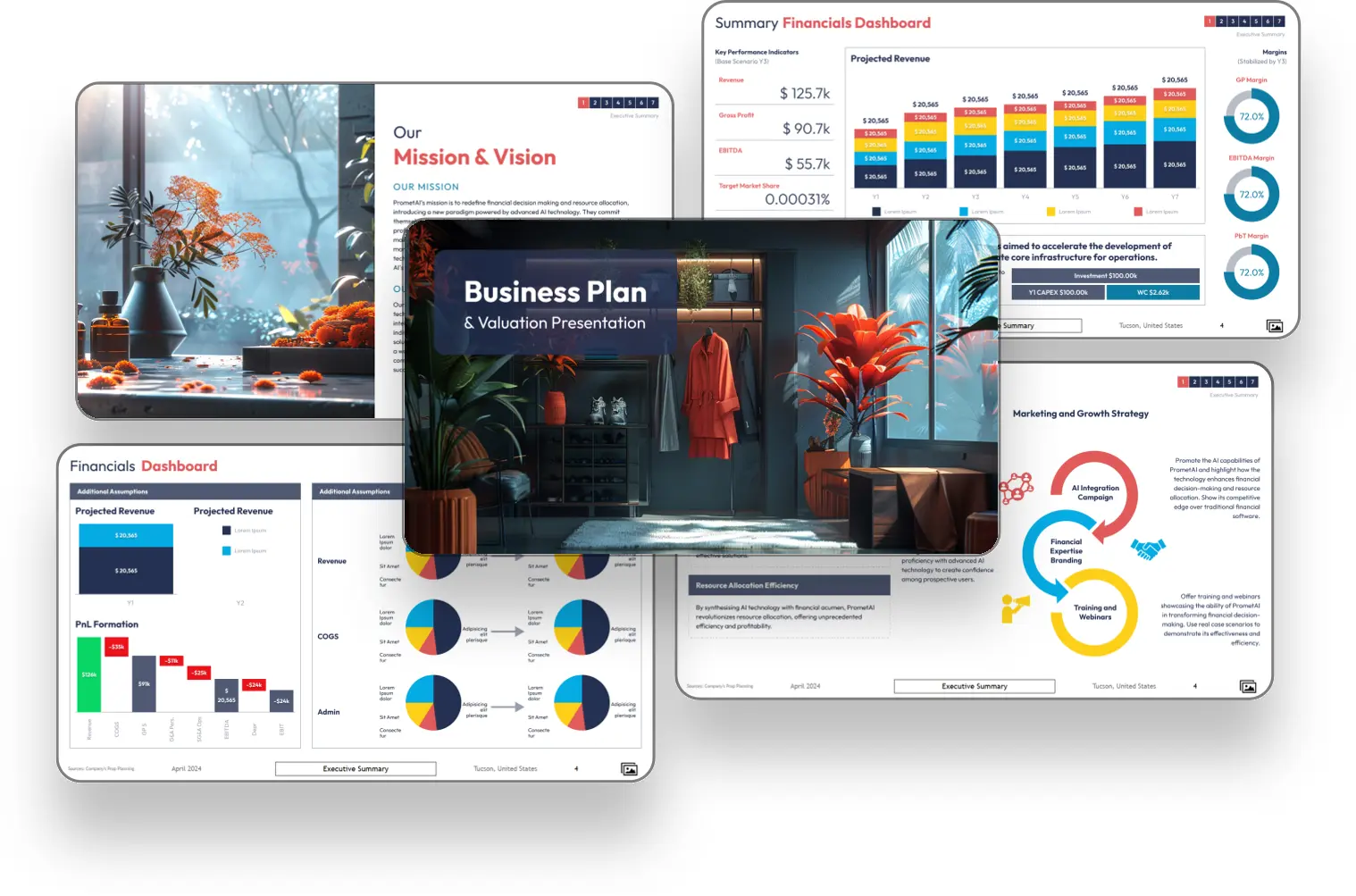
What You Get with PrometAI’s Ecommerce Business Plan Template

Executive summary

Executive summary

Market analysis

Market analysis

Revenue model

Revenue model

Cost Structure

Cost Structure

Financial projections

Financial projections

Funding strategy

Funding strategy

Risk analysis

Risk analysis

Production planning

Production planning

What Makes a Strong Business Plan
for an Ecommerce Startup

In ecommerce, investors expect more than a simple growth story. They want a clear business plan template for ecommerce startup that explains how the business attracts and keeps customers. They also look at how sales channels support profits and whether the growth plan remains realistic after costs like marketing, returns, inventory, and delivery are included.

Ecommerce Business Plan Template Evaluation Criteria

A strong plan should clearly show how the business stands out. This can come from unique products, access to marketplaces, and repeat customers. In Nordic Gear Co.’s case, the plan builds credibility by combining sustainable products, multi-channel sales, centralized logistics, and a focus on customer retention.

A good plan also accepts real challenges. In this case, key issues include a crowded apparel market, high customer acquisition costs, seasonal inventory, and the shift from a small founder-led setup to a scalable business. Investors will check if the company can handle these challenges while managing cash properly and growing at a realistic pace.

Ecommerce Business Plan Template

Financial Planning Considerations
for Your Ecommerce Business

In ecommerce, financial planning should reflect how the business actually operates, not just show percentage growth. A strong Ecommerce Business Plan Sample should focus on key areas such as sales channels, inventory timing, logistics, and how much capital is needed before the business reaches better margins. An online store business plan template should make these points clear and easy to understand.

Capital deployment

Capital deployment

Early-stage plans should clearly separate different types of spending. This includes investment in assets, operating cash needs, and working capital. This helps investors understand how the funding will be used.

Acquisition efficiency

Acquisition efficiency

High customer acquisition costs require careful planning. The model should connect paid growth with customer retention, lower churn, and higher lifetime value.

Fulfillment economics

Fulfillment economics

Logistics is a key part of the business. Shipping speed, centralized warehousing, and delivery costs directly affect customer experience and profit.

Seasonal working capital

Seasonal working capital

Apparel businesses with seasonal demand need to plan inventory in advance. This includes building stock before peak seasons and managing cash to support it.

Channel mix

Channel mix

Revenue should be planned by channel. Direct sales, marketplaces, wholesale, and other channels have different margins and levels of control.

Common Mistakes in
Ecommerce Business Plans

01

Overstated scale

Forecasts often assume rapid market capture without proving how brand awareness, marketplace traction, and retention improve over time.

05

Shallow investor readiness

Plans often mention growth initiatives but fail to connect governance, risk mitigation, scenario testing, and funding use into one coherent capital case.

04

Flat margin assumptions

Treating gross margin as stable without reflecting raw materials, manufacturing, and shipping dynamics weakens investor confidence.

03

Underbuilt inventory model

Seasonal stock requirements are frequently simplified, which hides working-capital strain and cash-flow volatility.

02

Weak CAC logic

Many plans present customer growth without showing how acquisition costs behave in a crowded category.

Why Founders Use PrometAI
to Build Their Ecommerce Plan

PrometAI, as an AI business plan generator, helps founders create more structured and clear business plans. It replaces unclear narrative with model-based planning. As a result, key areas such as revenue, costs, investment needs, and risks become clear and visible.

For ecommerce businesses, this is important because investors expect well-organized and complete planning. A strong plan should bring everything together in one place. This includes sales channels, working capital, scenario testing, valuation, and risk. In addition, features like AI-guided planning, automated financial modeling, valuation support, and stress testing help improve both accuracy and presentation.

Why Founders Use PrometAI

Example Structure of an Ecommerce Business Plan

This Ecommerce Business Plan Sample shows a clear and simple structure that founders can follow. It explains each part of the business in an easy and step-by-step way.

Sections

1. Executive Overview (Mission, Vision & Business Concept)

9. Scenario Analysis, Stress Testing & Financial Simulations

8. Risk Management & Compliance Considerations

7. Financial Overview (Revenue Model, Investment & Key Metrics)

6. Operations & Organizational Structure

5. Competitive Positioning & Strategic Analysis

4. Growth Strategy & Development Phases

3. Market Opportunity & Target Customers

2. Company Overview & Product Offering

Read More

FAQs